Hey folks, let’s cut to the chase – if you’ve ever worked with film blowing machines, you know the rewinding system isn’t just some afterthought. It’s the part that turns that wobbly, freshly blown bubble of plastic into a neat, usable roll that actually works for packaging, agricultural films, whatever you’re cranking out. I’m the guy who’s been supplying film blowing machines for over a decade, and I get it – most operators just press a button and hope it doesn’t mess up, but knowing how it actually works can save you hours of downtime, scrap material, and headaches. Let’s break this down like we’re chatting over a coffee, no jargon overload, promise. Film Blowing Machine
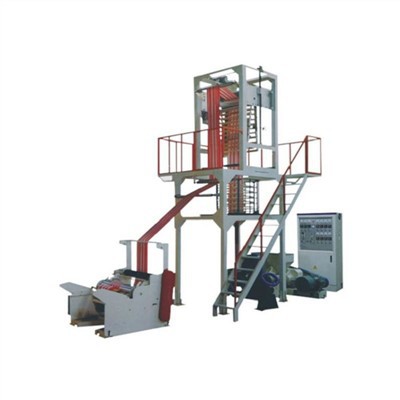
First off, let’s set the scene. When you run a film blowing machine, plastic resin pellets get melted, extruded through a circular die, air gets blown up the center to make that thin, hollow bubble (the part everyone calls the “bubble tower”), then it’s cooled with rings around the die so it firms up before it gets flattened into two layers, right? That flattened film, usually called the “layflat,” then moves along a set of rollers toward the rewinder. If that rewinder doesn’t sync up perfectly with the speed at which the film is being produced? You either get a loose, wrinkled roll that falls apart the second you try to unspool it, or you stretch the film so tight it tears, leaving you with a pile of useless plastic and a machine that’s idle. Not ideal.
So how does the rewinding system actually pull this off? Let’s start with the core components – I see a lot of new operators confuse these parts, so let’s name ‘em simply. There’s the unwind stand? No, wait, that’s for if you’re feeding in pre-made film, we’re talking about the rewind end, so let’s get that straight: first, after the layflat passes through the frame, you’ve got a set of “nip rollers” right before the rewinder. These aren’t just regular rollers – they’re two hard, rubber-coated rollers that squeeze the flat film between them. Their job is twofold: pull the film consistently from the bubble section so you don’t get that bubble bouncing (which causes thickness variations), and also apply a tiny bit of tension to keep the film straight before it hits the winding arm. If these nip rollers slip, that tension drops, and you’re looking at a wrinkled layflat – waste, right off the bat.
Next up, the winding core or “mandrel” – that’s what the actual roll is wound around. Some machines use a single core, some use a turret with two cores, which is a game-changer for production speed. Here’s why: if you’re using a single core, you have to stop the machine, remove the full roll, slap on a new core, and thread the film back through. That’s 10, 15 minutes of downtime, depending on your setup. A turret rewinder has two cores spinning on a rotating arm – when one roll gets to its desired width or weight, the arm swings the empty core into position, you splice the new film to the end of the full roll without stopping the machine, and keep going. That’s why turret rewinders are standard on high-output lines now – nobody wants to shut down every time a roll is full.
Now, the part that trips most people up: tension control. This is make or break. If the tension is too low, the roll is soft, it collapses when you pick it up, and the edges are wrinkled. Too high, and you stretch the film – thin spots, tears, even the film can break mid-wind, and you’re back to splicing. How does the rewinder regulate this? There’s usually a load cell or a dancer roll system here. A dancer roll is like a spring-loaded roller that sits above or below the film path, right before it wraps around the core. As the roll gets bigger (when it’s winding), the dancer moves down, and sensors pick up that movement – that tells the rewinder’s motor to adjust its speed. Let’s say: when you start a new roll, the core is small, so the circumference is low, meaning if the motor spun it at the same speed as a full roll, it would pull way too much film, causing over-tension. The dancer senses that movement, sends a signal, and the motor slows down just enough to keep tension consistent. That’s key – constant tension from start to finish of the roll.
Wait, let’s make that concrete with an example. Suppose you’re making a 23-inch wide poly bag film, outputting 500 feet per minute. At the start of the roll, the core is 3 inches in diameter, so its circumference is ~9.4 inches. To keep the film moving at 500 fpm, the core has to spin 500 / 9.4 ≈ 53 times a minute. By the end of the roll, you have a 12-inch diameter roll, circumference ~37.7 inches. Now you only need 500 / 37.7 ≈ 13.2 spins a minute. If the rewinder didn’t slow down, that roll would spin way too fast, pull the film tight as a guitar string, and pop. The dancer roll and load cell handle that speed adjustment automatically – that’s why you don’t have to mess with it manually after setting the initial tension, as long as your film material changes.
Speaking of material – that’s another thing I teach customers all the time. If you’re winding a stretchy material like LDPE (low-density polyethylene), you need a bit less tension than if you’re winding a rigid material like PP (polypropylene). Stretch film, for example, needs just enough tension to keep the roll tight, but not so much that the film stretches while winding, which would make it useless for its intended purpose (it won’t stretch right when you go to wrap pallets). Thick agricultural mulch film? You can crank the tension a little higher, since it’s sturdier. The rewinder’s control panel (we use digital touchscreens on all our machines, no analog dials for the main control anymore) lets you input material type, roll width, core size, and it auto-calibrates most of that – that’s a feature I pushed for when we designed our mid-range machines, because I saw customers wasting so much time on manual settings.
Wait, there’s also edge guide control, right? That’s a tiny but super important part. The layflat film isn’t always perfectly straight – after it comes out of the bubble, it can drift left or right a little, and if the film is off-center when you wind it, you get a lopsided roll with folded edges. Edge guides use sensors (usually optical, since they work on plastic) that detect where the edge of the film is, and tiny motors adjust the nip rollers or the turret arm to nudge the film back into place. Some cheap rewinding systems skip this, but if you’re producing for commercial use, you need it. I’ve had customers come to us after buying a used machine with a broken edge guide, and they were throwing away 10-15% of their material every day just because rolls were lopsided. That’s a cost that adds up fast – $10k a month in scrap for a mid-sized plant, easy.
Let’s talk about common issues, because that’s what actually matters to operators. What if your rewinder is making wrinkled rolls? First check the nip rollers – are they dirty? If plastic residue builds up on the rubber, they can’t grip the film evenly, so one side slides, causing wrinkles. Easy fix: stop the machine, clean the rollers with isopropyl alcohol, do that every 8 hours of run time. Another common issue: tension drifts as the roll gets bigger. That’s usually a bad dancer roll spring, or a sensor that’s out of calibration. I see this all the time with older machines – the springs get worn, so they don’t apply consistent pressure, so tension drops. We stock replacement dancer springs and sensors for all the machines we sell, so if you run into that, you can get a part same-day in most areas, no downtime waiting for overseas parts.
Wait, let’s circle back to the turret rewinder, because that’s the big upgrade people ask about. When the turret arm swings to switch cores, there’s a splice unit – either a thermal splicer (uses heat to melt the two ends of the film together) or a tape splicer (uses heavy-duty packaging tape to stick the new film to the end of the full roll). Thermal is better for thin films, because the splice is almost invisible and strong enough that you don’t get a break when you unspool later. Tape is cheaper, good for thicker films, but you have to make sure the tape doesn’t leave residue on the roll if it’s going to be printed later. Our machines let operators pick which splice they want, depending on their output – that customization is something I learned early on, because every customer’s needs are different.
Let me wrap this up with why all this matters, beyond just “making a roll.” The rewinding system is the last step before your film goes to slitting, printing, or end users. If it’s not working right, all the work that went into blowing the bubble, cooling it, getting the thickness just right is wasted. I’ve had customers tell me they thought their film blowing machine was bad, when it was just a misadjusted rewinder. That’s why knowing how it works, and how to tweak it, saves you money more than any other part of the machine.
If you’re in the market for a film blowing machine, or your current rewinding system is causing too much scrap or downtime, hit me up. I’ve got 15+ years helping folks pick the right setup, whether you’re a small shop making poly bags or a large plant doing agricultural film. I don’t do pushy sales, I just get that you need a machine that works when you need it, no headaches. Let’s chat about your production needs, and we can figure out a rewinding system that fits your output, material, and budget.
Mechanical Parts References:
- Ghosh, P. K. (2017). Polymer Processing: Principles and Design. Hanser Publications.
- Rosato, D. V., & Rosato, M. G. (2004. Extruding Plastics: A Practical Processing Handbook. Springer.
- Society of Plastics Engineers (SPE). (2020). Film Blowing and Casting Technology: Best Practices for Operators. SPE Education Foundation.
- Rauwendaal, C. (2014). Polymer Extrusion (5th ed.). Hanser Publications.
Ruian Huawei Machinery Co., Ltd.
As one of the most professional film blowing machine manufacturers and suppliers in China, we’re featured by quality products and low price. Please rest assured to buy discount film blowing machine made in China here from our factory. Also, quotation is available.
Address: No. 1, Building 2, Jingye Road, Dongshan Street, Rui’an City, Zhejiang Province
E-mail: 13695753569@163.com
WebSite: https://www.hw-machines.com/
