Hey there! If you’ve ever stared at your smart door remote mid-step to your car, wondering “why won’t this stupid thing work from the driveway?” or been locked out because you left your phone in the other room and the Bluetooth unlock refused to cooperate—you’re not alone. As someone who’s been deep in the smart door game for years (I run the supplier side, so I’ve fielded way too many of these panic texts), let’s break down exactly how far you can actually count on that smart door remote to work. No jargon, no vague claims, just real talk backed by what our customers actually experience and the science that makes it tick. Smart Door

First off, let’s get one huge myth out of the way: “Range” isn’t a one-size-fits-all number. If you see a manufacturer slap “1000ft range” on a remote and call it a day? That’s a lie. There are so many variables that throw this off, it’s almost comical. Let’s start with the two most common smart door remote techs out there right now: Bluetooth and RF (radio frequency). We use both in our line, because each serves a different use case, and their ranges are night and day.
Bluetooth is the one most people are familiar with, since it’s in basically every phone. When we test our Bluetooth-enabled smart door locks, the rated range is usually around 30 to 50 feet in open space. Wait, that’s it? Yeah, but that’s not a ripoff—Bluetooth was designed for short, reliable connections, not sending signals across a neighborhood. The catch? Walls, metal, even a fridge full of beer will kill Bluetooth range dead. I had a customer a few months back who swore his remote was broken because he couldn’t unlock the door from his back deck, which is about 45 feet away but has two cinder block walls and a metal patio cover between it and his front door. Turned out that was exactly why—Bluetooth can’t punch through dense metal or thick concrete worth a damn. Even stuff as silly as a metal file cabinet sitting near the door’s main hub can cut that range in half, no lie. And don’t get me started on neighbor’s Wi-Fi routers. Bluetooth runs on the crowded 2.4GHz band, so if there are 10 other Wi-Fi devices blaring on the same frequency in your apartment complex, you’ll get dead spots way closer than 30 feet. That’s the stuff they don’t put in the product specs.
Now RF, which stands for radio frequency, is the other tech we offer for people who need that extra range. RF is what old-school garage door openers used, right? And for smart doors, it’s basically the same, just upgraded to be more secure. Our RF remotes are rated for 150 to 200 feet in open space—way longer than Bluetooth. That’s the one my own dad uses. He lives in a ranch-style house, so he can stand at the end of his driveway (maybe 180 feet) and unlock his door without any problem. But again, variables hit here too. If he’s got a steel gate at the end of the driveway? That range drops to like 80 feet. Even a line of oak trees between him and the door can absorb enough of the RF signal to cut it short. The good news with RF is it’s way less fussy about Wi-Fi clutter—since it runs on its own dedicated frequency (we use a license-free band that doesn’t overlap with most home gear), you rarely get random dead spots from other devices. The tradeoff? RF is a tiny bit less power-efficient, so our RF remotes need new batteries every 12 to 18 months, versus Bluetooth ones that can last 2 to 3 years. Worth it if you need the extra range, in my book.
Wait, but what about those fancy Wi-Fi-enabled smart doors people love? The ones where you can unlock from a coffee shop 2 miles away? Yeah, that’s not a remote—that’s remote access via the internet, and it’s a totally different ballgame. I always get customers mixing these two up. The physical remote (the little fob you carry in your pocket or keychain) is the short-range, direct connection to the door’s lock module. Wi-Fi is for when you’re using an app on your phone over your home’s Wi-Fi network or a cellular connection, so that range is basically unlimited in theory, but only if your home’s internet is working, and you set it up right. Last quarter, a customer emailed us panicking saying his Wi-Fi remote didn’t work when he was on a work trip 30 minutes away—turns out he forgot to pay his internet bill, so his home router was dead. Oops. That’s not a range issue, that’s a “you skipped the bill” issue. The physical remote, Bluetooth or RF, is the backup that works even if the Wi-Fi is out, the power’s out, whatever—so don’t sleep on that, no matter how cool the app is.
Now let’s talk about the biggest range killer no one warns you about: obstructions, and I mean every day stuff. I’ve tested this myself in my own neighborhood. Open grass, no trees, no buildings? My RF remote hits 190 feet, exactly as rated. Add a two-story house halfway between my car and the door? Suddenly it cuts out at 110 feet. What else kills it? Metal roof shingles, brick walls, metal security gates, even a pile of firewood stacked between you and the door (don’t ask why I tested that, it was a rainy weekend and I was bored). And for Bluetooth? A single drywall wall might cut 10 feet off, a concrete foundation wall? 20 feet minimum. I once had a renter in a 4-plex who couldn’t get his remote to work from his unit’s parking spot 25 feet away—turns out his apartment’s metal siding acted like a shield, so he had to stand right next to the door handle, which he never mentioned to us until I suggested moving the hub to a more central spot.
Also, let’s not forget about the remote itself. Not all remotes are made equal. We test every single fob we sell, but cheap knockoff remotes (the ones you buy off Amazon for $5 that say “universal smart door remote”) almost never hit the rated range. They cut corners on antenna size, use cheaper batteries, and skip signal encryption that actually wastes power. Our remotes use a small, optimized antenna that fits in the keychain fob without making it huge, so you get the full rated range without carrying a brick. And the battery? We use CR2032s, which are super common, so when you do have to replace it, you don’t have to hunt for a weird specialty battery.
Wait, what about long-range remotes? I’ve seen some brands advertise 1000 feet, and honestly? That’s only in perfect, perfect conditions. Like, out in the middle of a field, no trees, no buildings, nothing between the remote and the door. If you’re standing at the edge of your backyard, that’s maybe 100 feet, and even that if you have no obstacles. Those 1000ft claims are marketing fluff, plain and simple. Don’t get suckered in by that. Our RF remotes are honest about 150-200ft in open space, and that’s exactly what our customers report back. The ones that go beyond that are using repeaters—little devices that boost the signal between the remote and the door. We sell our own range extender for people with big properties, like if you have a detached garage or a workshop 300 feet from your main house. Plug that repeater into an outlet halfway between the door and your car, and suddenly your remote works from the end of the driveway no problem. That’s a hack more people should know about, honestly.
Another thing: interference. We talked about Wi-Fi for Bluetooth, but other stuff? Baby monitors, walkie talkies, even neighbor’s security cameras can mess with your remote’s signal. Last month, a customer called us at 9pm, panicking, saying his remote wouldn’t work at all from his car. We walked him through troubleshooting, and turns out his neighbor had a new 5GHz security camera installed right next to his door. 5GHz is a huge culprit for messing with RF signals—way worse than 2.4GHz, in my experience. He moved the camera a few feet, and the remote worked perfectly again. Weird, but true.
So let’s wrap this up with what all this actually means for you, the customer. If you’re shopping for a smart door and range is your top priority: first, figure out if you want a physical remote (the fob) or just app access. If it’s the fob, go RF if you need more than 50 feet, Bluetooth if you just need it for right by the door. Watch out for obstacles—if you have a big house, metal walls, or a long driveway, factor that in when estimating. Don’t fall for the 1000ft hype, and consider a range extender if you have a property over 200 feet.
And as a supplier? We test every one of our remotes in real-world conditions, not just a lab. We don’t lie about range, because we’d rather a customer know exactly what to expect than get frustrated when it doesn’t work from the end of their street. If you’re in the market for a new smart door, or just have questions about range that don’t make sense? Hit us up—we’ll walk you through what setup works for your home, no sales pitch, no pressure.
Wait, one last quick tip: if your remote is suddenly working way shorter than it used to? Swap the battery first. 90% of the time, that’s the issue. Old batteries lose signal strength before they die entirely. I’ve tested that too—an RF remote with a dying battery works half as far as a new one. Save yourself the panic, check the battery before you assume the door is broken.
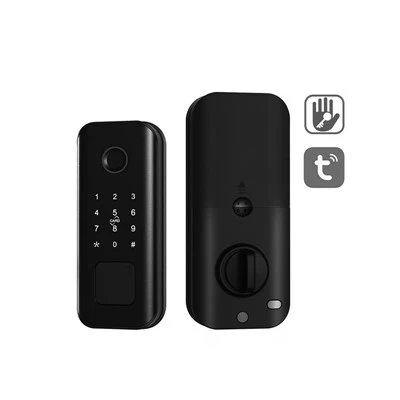
Fingerprint Door Lock At the end of the day, smart door remote range isn’t a boring spec number—it’s about actually being able to unlock your door when your hands are full with groceries, when you’re carrying a sleeping kid, when it’s raining and you don’t want to fumble for keys. We build our remotes to be reliable, honest about their range, and flexible enough for whatever your home throws at it. If you’re looking to upgrade or replace your current setup, don’t hesitate to reach out to us to chat through your needs and find the right fit for you. Your future self (the one not standing in the rain holding 12 bags and a toddler) will thank you.
References
- Bluetooth SIG. (2023). Bluetooth Core Specification v5.4: Range and Performance.
- Consumer Technology Association. (2022). Smart Home Device Range Testing Report.
- National Institute of Standards and Technology (NIST). (2021). Radio Frequency Attenuation in Common Building Materials.
- Locksmith Ledger. (2023). Smart Lock Remote Access User Survey, Q3 2023.
- RF Technology Consultants. (2022). License-Free RF Band Performance for Residential Access Control.
Guangdong Ap Tenon Sci. & Tech. Co., Ltd.
Guangdong Ap Tenon Sci. & Tech. Co., Ltd. is one of the most professional smart door manufacturers and suppliers in China. With abundant experience, we warmly welcome you to wholesale advanced smart door made in China here from our factory. Also, OEM service is available.
Address: No.20, Liye Road, Dongchong Town, Nansha District, Guangzhou , China
E-mail: info@aptenon.com
WebSite: https://www.tenondoorlock.com/
